What you need to know about trading
-
This post is intended to save people time and money, because they are very often misleading about trading. They follow bad advice from people they don't know the interest, and aren't aware about their own biases. I will then try to clarify what motivates the vendors, what are the actual rules of the market, and how to deal with it.
THE VENDORS AND THEIR INTERESTS
The interest of the brokers
Brokers are private companies whose interest is financial. They are mainly making profit with the transaction costs(fees). They often are a percentage of the amount you invest in the asset. Commissions are only part of the fees which are often present even with 0 commission. So the more you invest at once, and the more frequently you open and close positions, the more they make profit. The current trading enthusiasm is then a phenomena they have a big interest to maintain. Somebody who longs over a year, compared to one who buys and sells(trades) once per day, the same amount, would bring 260x less money to the broker.
The interest of the influencers
With this in mind, brokers often engage internally, or externally(like the influencers), commercials to present some trading strategies to the public. Trading strategies they promise a great profitability with, are the most likely to attract people to the website. They are then redirected toward some trading products, brokers, they can apply the strategy on. The broker pays the influencer for the advertising he made. Therefore, the broker can benefit from more clients, and these clients induced to make frequent trades by using trading strategies(scalping like), bring him even more profit. See fig 1.
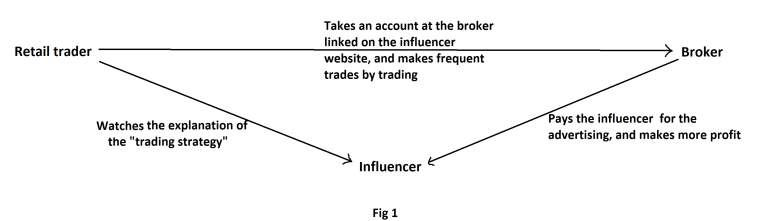
However these "strategies" used as a pretext don't show any significant profitability.
THE RULES OF THE MARKET
Measuring the worthiness of a strategy
A trading strategy is worth it when it allows to significantly overperform the market. Overperforming means having an higher increase rate than the instrument you are trading. If on a given period the USP500 goes up by +20%, and on the same period the strategy makes here +15%, it's not overperforming(underperforming). If the strategy overperforms an asset on a short period, or just with a few trades for example, it is not significant, it can be due to luck. There is an infinite number of ways to measure the significance of a result, with many possible different criteria, each manner being more or less good. Among these criteria it can be said that : the more trades were made; the longer the period; the better they are spread over the period; the most regular is the increase rate, on unknown data(price), the more it is significant.
Why common strategies can't work
Trading is a zero-sum game. The sum of the gains of winning people equals the sum of the losses of loosing ones, subtracting transaction costs. See fig 2(it ignores transaction costs).
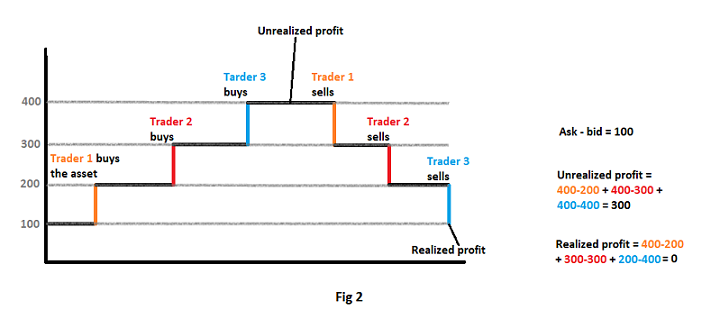
It is a competition. The better are the others, the harder it will be to make money. Deduction made of transaction costs it doesn't necessarily mean that there would be as much winners as loosers. Because those performing are also investing more than beginners. 1000 newbie retail traders investing 1.000USD compete against Elon Musk investing 1.000.000USD on a powerful trading algorithm built by a team of very smart and competent statisticians. That's why a majority of people are loosing money.
Knowing that not everybody can win, the only fact that a strategy becomes widely exploited makes it obsolete. See fig 3.
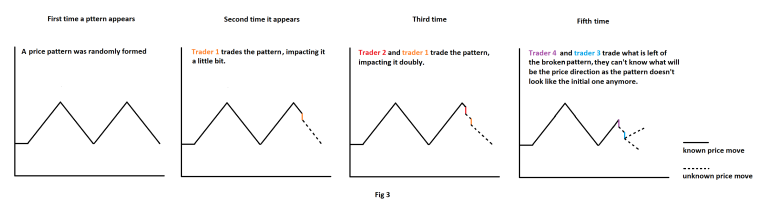
Trends are petterns like others, unlike real objects, the price dosen't benefit from a momentum effect. See how it would vanish over time. See fig 4.
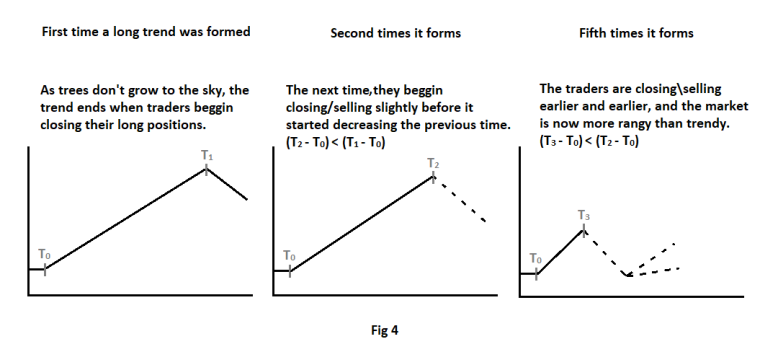
This kind of simple(too much) strategy is not capable of predicting the price movements, which is(the price) much more stochastic(chaotic), and is governed by petterns with more complex structures.Strategies that are not strategies
Systems that are like martingale, grid, hedging are not strategies themself, they only are money managements. A way of invessting that needs to be part of a bigger system, which can predict/forecast price movements. The martingale system itself consists in doubling the traded amount every loss. Supposing the stop-loss equals the take-profit, the probability of winning(W) equals those of loosing(L).
W=1/2; L=1/2;
The amount you risk losing after x losses(starting with 1) = 2^x;
The probability of loosing x times = 1/2^x.
It means any x consecutive losses happen 1/2^x times, with a lost amount of 2^x;
1/2^x * 2^x = 2^x/2^x = 1/1.
Which means that on the long run you loose as much money as you gain. This 1/1 ratio is valid for any betting system like those cited above, no matter the ratio SL/TP.How different are working strategies
Hard question but, as I said only the strategies that can predict/forecast(with a given probability) price movements, are able to overperform significantly the market. For me, the down side of traditional strategies is the fact that they exploit only a very local information of the price, and one rigid aspect of it. The working strategies that are not machine learning, are probably very rare, and have to be very exotic compared to what traditional trading strategies, chartism like, are. Those belonging to machine learning are far more common nowadays. Their system is more complex, the same way they are able to apprehend more complex patterns. They also are more adaptive as one can work on different timeframes, assets, and even type of assets.
TIPS THAT WORK
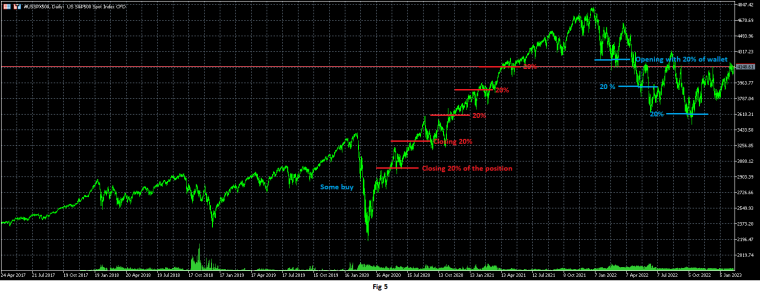
There are still possibilities of making money "trading" without predicting price movements. As the world becomes economically richer, agents buy faster than they sell, so it still is possible marking money by longing some assets. By buying some stocks, at a good(low) price preferably, diversifying them, to decrease the risk. It is said that stocks underperforming the market on a given period, tend to overperform it later. Progressive entries and exits are also preferable, they can prevent you from loosing an entire trade because of one pip. Let say by opening a position with x% of your wallet each fixed step, or each % step of the price. See fig 5.
You can beside hold currency pairs in the direction of the swaprate. The swaprate is at the same time a certain but risked revenue because, you need to hold the asset and are exposed to its fluctuations. A leverage can then be used sparingly. If the maximum decrease of the pair on the past years was about 50% from highest to lowest points, you can hope using a leverage of 2 without blowing up the account, plus the margin of the swaprate which gives you a regular income. See below :
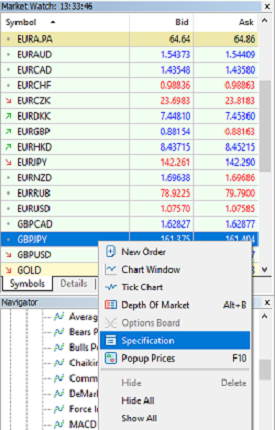
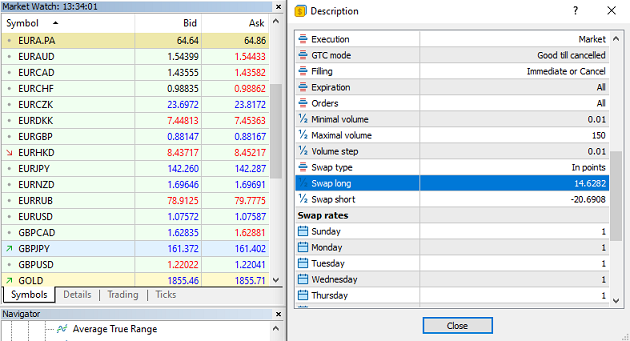
The swaprate is expressed in points per day. 14,6s=14,6 * 0,00001 * 365 / quote currency=0.03%/year multiplied by the leverage. We can imagine an automated way of distributing the money by currency pairs, depending on their swaprate and their risk, which change over time. The higher the swaprate and the lower the risk the more you invest on it. The diversification of holding different pairs also decreases the risk.
-
@seb-0 se ve mucho cuando los influeser te mandan religiosamente a poner stop loss , cuando el algoritmo busca estos stop loss y los liquida.
-
@seb-0 Thank you for sharing.
-
GREAT, what this strategy for? gold?
-
@CAVINCENT
As you can see at the top left of the picture this is the graph of the S&P 500. It's rather dedicated to equities, but you can imagine doing it on gold as it follows inflation. Machine learning works also.


