I want to use the atr as an input filter, to only place operations when there is good volatility, but I don't know how to do it and connect with the other conditions
-
I want to use the atr as an input filter, to only place operations when there is good volatility, but I don't know how to do it and connect with the other conditions
Luis Martinez
-
@luisjunior1224
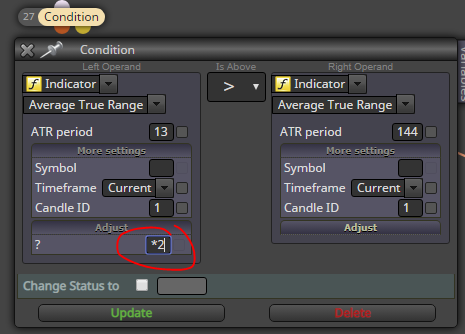
One method is to compare fast (13) and slow (144) ATR to each other.
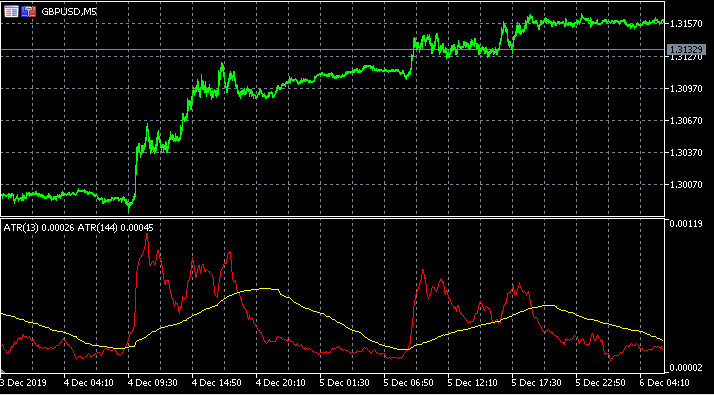
You can also set a multiplier. For example, adjust *2 means that fast ATR must be double that of slow ATR.
-
thank you very much, and if I turn it upside down it would be for a range operation
Luis Martinez
-
@luisjunior1224 Well, you should always trade only the volatile period (fast above slow), no matter if there is a trend or not.
Fast below slow means that the price doesn't move at all -> your profits are small but spread+commission stays the same. Not wise to trade that. -
@roar Without the multiplier does not work?
what is the logic applied here with respect to the multiplier
-
@luisjunior1224 You could use any multiplicator for short term atr - even , if you like. It should just indicate that the short term average of atr is bigger than the long term atr. In @roar 's case he assumes that good volatility if 2 times short atr is bigger than long term atr.
-
The number 2 was just an example, its probably too big for most cases. You can try 0.7, 1.0, 1.3, 1.7 etc. Its very easy to optimize, just one number to measure volatility.
-
@roar In your experience, which has worked the most for you as a multiplier
Luis Martinez
-
@roar what period of ATR do you recommend if I want the sl to be for atr
-
@luisjunior1224 Start with 2* ATR value for begining. That's a fair value usually. However, it depends also on timeframe if you use default period of 14. On M1 you'd just cover the last 14 minutes and on D1 the last 14 days.
-
@luisjunior1224 Just to give you a feeling about ATR maybe and because I have good mood today, here is a very useful custom indicator for all kinds of moving averages. I tweaked it a bit that it shows an ATR band (1 line above MA line and one below). You can adjust the multiplicator in the settings as well as the ATR period.
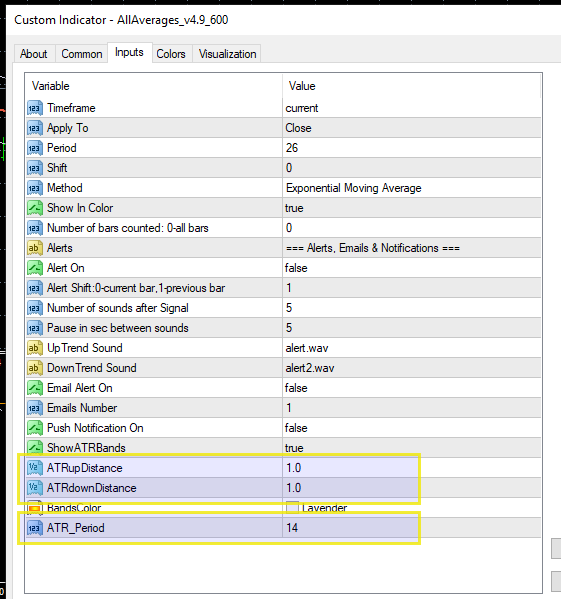
0_1575851025517_AllAverages_v4.9_600.mq4
And that's how it looks like on the chart.
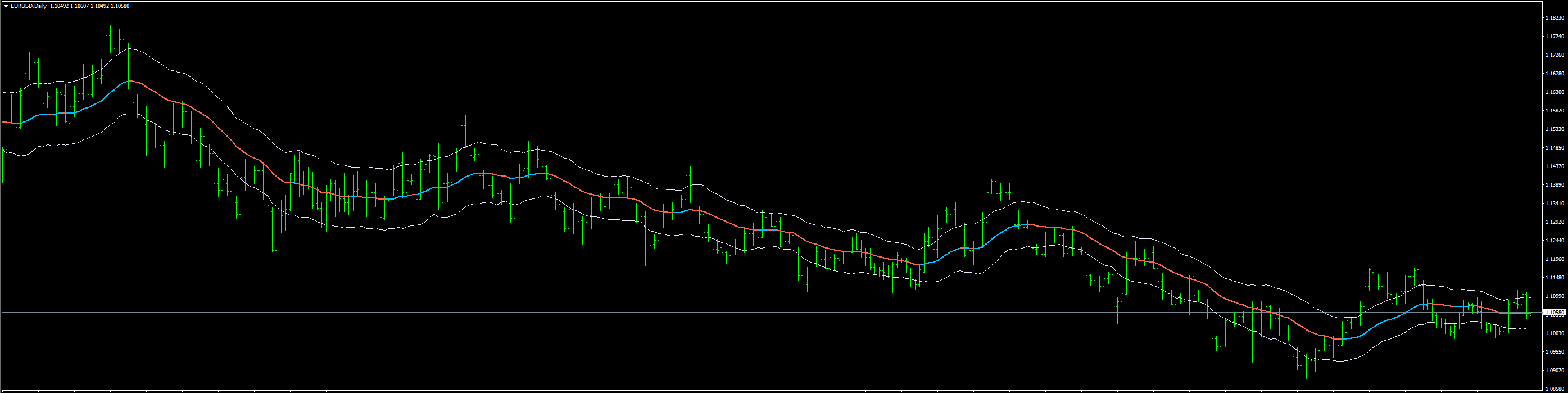
If you set MA period to 1 you'd have your SL based on ATR (candle close for instance).
-
@trader-philipps Do you have a robot with that indicator?
-
@luisjunior1224 You can easily build by yourself. You can import the the indicator into fxdreema and use it. Most strategies use any kind of Moving Average - at least the trend following ones.
Btw. I just implemented the ATR bands vor current timeframe as I just need it that way.
-
@roar Just to confirm, is 144 or 14 the atr?
-
@luisjunior1224 The default value for ATR in MT is 14. you can use a multiplied value of that (for instance by 2) for initial SL.
What @roar wanted to show is 1 way to measure volatility. That has nothing to do with SL. So he took the ATR of a long periood (144) and compared it with the ATR of a shorter period (13) in his example. In this case you'd enter trades only, if ATR(13) is bigger than ATR(144). Keep in mind that ATR is directionless!
I like to share my knowledge, but expect the others to contribute as well.
-
@trader-philipps I for one was very happy that you were in a good mood because you have taught me a lot in this post plus.... presents before Christmas.. lol .. Thank you!
-
@luisjunior1224 said in I want to use the atr as an input filter, to only place operations when there is good volatility, but I don't know how to do it and connect with the other conditions:
@roar In your experience, which has worked the most for you as a multiplier
It really depends on the timeframe and your strategy - how many trades per day do you plan to take?
If I go for a M5 scalping strategy, I would use fast ATR 13, slow ATR 377, and a multiplier 1.1 as a start. Later optimize for multipliers ranging from maybe 0.7 - 2.1.
It's not really some mystical fact, like "1.1 multiplier gives you the most million $".
ATR is just a filtering tool, you must fit it together with the rest of your strategy
-
@roar thants bro

-
@trader-philipps Hey folks, the AllAverages indicator I posted above was anly showing ATR bands on the current TF. Here is a version that also shows the ATR bands on a higher TF (with higher TF ATR).


